Powering the AI Era: How Utility and Broadband Growth Are Changing the Infrastructure Landscape
AI is fueling unprecedented growth in North America’s energy and broadband infrastructure. As utilities and contractors race to meet surging demand for data centers, electrification and fiber connectivity; efficient, coordinated worksite safety has never been more important.

Key Takeaways
- AI is driving massive growth in energy and broadband demand, with data centers and electrification pushing utilities toward decades-high infrastructure investment.
- Simultaneous expansion of electric and fiber networks is creating 1990s-level infrastructure acceleration, increasing pressure to deliver safely, efficiently, and at scale.
- Utilities and broadband providers are turning to integrated safety partners to improve coordination, permitting, and multi-state project execution.
- Success in the AI era will hinge on proactive planning and synchronized supply-chain operations, from materials and permitting, to traffic control and worksite safety.
Q: the impact of AI is making headlines across industries. How do you see it affecting utility and broadband infrastructure?
What a lot of people don’t realize is how energy-intensive artificial intelligence really is. Generating a single AI image can use up to 10,000 times more energy than a standard web search. When you multiply that across millions of users, you start to see why this matters to utilities.
Data centers — which power everything from ChatGPT to cloud storage — require massive amounts of electricity. That’s leading to unprecedented investment in electric utility infrastructure. One state study, for example, forecasted that New Jersey could triple its megawatt consumption over the next 15 years due to AI, electrification, and population growth. That level of sustained demand hasn’t happened in decades.
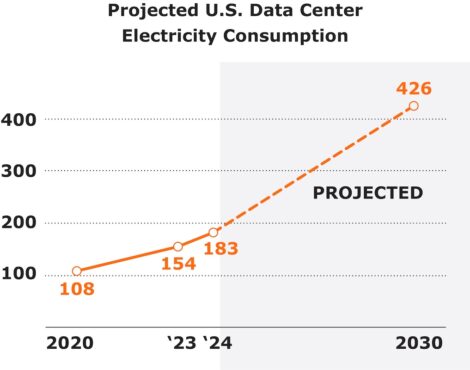
Source: International Energy Agency, Pew Research Center
The Energy Consumption Boom: Research from Pew shows U.S. data center energy usage at 4% of total electricity and on track to more than double by 2030. This means more work, more coordination and heightened urgency for utility crews.
Q: What does this surge in demand mean for construction and infrastructure companies?
It’s driving an incredible amount of utility and broadband work. We’re seeing forecasts that show utilities maintaining a strong compound annual growth rate (CAGR) for the next 20-plus years. And on the broadband side, the next five years will bring more fiber built than in all the previous years combined.
Think about that — energy and fiber expansion happening at the same time, across nearly every state. It’s very similar to what we saw in the early internet era of the 1990s. This growth is creating tremendous opportunity, but it’s also creating pressure to deliver safely, on schedule, and across huge geographic footprints.
Q: How is AWP Safety helping customers stay ahead in such a fast-changing environment?
We’re aligning our business to match how large utility and broadband companies operate — at scale and across multiple regions. Our Traffic Management Office (TMO) provides centralized traffic management and safety planning and coordination for customers with projects spanning several states or regions. That means fewer scheduling conflicts, more efficient permitting, and better visibility into what’s happening across their entire footprint.
For our Strategic Alliance Program customers, it goes even further. They receive dedicated support that connects AWP’s field operations, safety teams, and commercial leaders so we can act as an extension of their organization. When we collaborate closely and share ownership of outcomes, we all win — and our customers see that efficiency reflected in reduced downtime, fewer overtime hours, and safer worksites.
Q: What’s next for the management industry as this growth accelerates?
The pace of work is only going to intensify. In the first half of this year, many broadband and utility projects were delayed by bad weather and fiber supply challenges. Those constraints are easing now, and with more funding beginning to flow, crews are preparing for a surge of activity in 2026 and beyond.
That makes now the time for companies to plan — not just for construction capacity, but for the entire ecosystem that supports it. From permitting and materials to worksite safety and logistics, every link in the supply chain will need to work in sync to meet demand. The partners that plan ahead, coordinate efficiently, and keep crews moving safely are the ones who will capture the opportunity that’s in front of all of us.
Learn how AWP Safety applies technology like Intelligent Transportation Systems, Automated Flagger Assistance Devices and connected cones to help prevent infrastructure work zone accidents — and improve public safety in communities across North America.