
Traffic Control as Strategic Infrastructure
Why “First Call” Planning Protects Safety, Schedules, Budgets, and Community Trust
In large utility and broadband programs, traffic control challenges don’t just affect what happens in the work zone — they also impact schedule reliability, cost performance, and the trust communities place in the work.
Bringing traffic control into the plan early strengthens four outcomes executives care about most: worker safety, schedule reliability, cost predictability, and public trust.

Key Takeaways
-
- Traffic control becomes strategic infrastructure when it influences permitting, sequencing, and resourcing early—not when it’s executed as next-day logistics.
- AWP Safety’s Safety Assurance Platform brings enterprise governance and visibility to customer operations across regions—improving their safety, timelines, and budgets.
- Early planning reduces risk, stabilizes schedules, and protects capital. This proactive strategic alignment turns traffic control from a cost to manage into a performance advantage.
- Proactive traffic planning improves productivity. Cancellation rates dropped dramatically in one electric utility program that previously cancelled 20% of jobs due to late coordination with their traffic control provider.
Q: Don, as utility and broadband companies grow, more leaders are viewing traffic control as a strategic enabler of their operations. What message do you have for those who may still view it as a commodity?
I’d start with a simple truth: when traffic control is treated like a commodity line item, you’re almost certainly paying for it elsewhere — in schedule volatility, permitting friction, unplanned overtime, and unnecessary safety exposure.
At scale, traffic control becomes a risk management discipline that touches compliance, permitting, labor utilization, fleet efficiency, and community perception. When it’s brought into the plan early, variability across all of those areas starts to narrow — leading to better workforce safety, on-time schedules and more predictable costs.
Q: What are the most common problems you see when traffic control is treated as a late-stage add-on?
When field teams call for traffic control support the night before a job starts, safety and sequencing decisions get compressed into hours instead of weeks. That’s when last-minute constraints like permitting delays, labor shortfalls and improper sequencing surface. Then the job has to absorb that in the form of overtime, rework, and budget misses.
Q: What does proactive, enterprise-level traffic control management look like in practice?
It starts with building traffic management into the design-and-construct process – not bolting it on at the end. Practically, that means a disciplined workflow: traffic control plans (TCPs) for every job, right-sized solutions aligned to the work, transparent budget visibility, support throughout permitting, service level agreement (SLA) -based execution, and clean reporting and billing.
When executed at the enterprise level, leaders can get earlier visibility, teams can schedule further ahead, and you can move from reactive ordering to enterprise coordination that saves time, effort, and money.
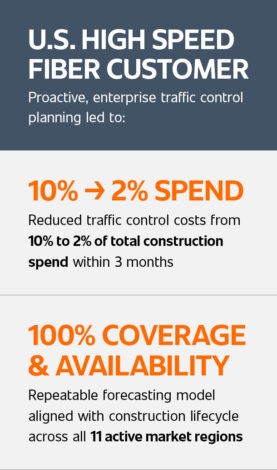
Here’s a great example: by elevating traffic control planning to the enterprise level — and planning more proactively — we helped one broadband customer reduce traffic control costs from 10% to 2% of total construction spend. Over time, that adds up to millions.
Q: The traffic control industry is shifting toward automated TCPs. How will that streamline work and costs for utility and broadband companies?
Right now, manual TCPs often lead to programs paying significant dollars for traffic control without a consistent way to validate what was needed versus what was really delivered. Automated planning generates compliant traffic control plans tied to every specific worksite location and setup — with a bill of materials and cost — making traffic control more traceable and measurable.
That changes the conversation for customers from unit prices to the full package: what the work required, what it cost, and whether it was appropriate for the risk profile of that location. In many cases, it reveals where traffic control setups can be streamlined to save costs.
Q: Where does risk-adjusted planning fit into this?
With the right inputs — traffic volume, crash history, seasonality — traffic control providers can use automation to recommend a standard compliant plan or a risk-adjusted plan when exposure warrants it. That is how we help customers elevate work zone safety beyond minimums and reduce the likelihood of life-altering events.
Q: What about multi-region programs? Do local compliance or relationships suffer when traffic control is managed at an enterprise level?
Inconsistent local management actually creates risk at scale: governance gaps, fragmented reporting, and no single view of exposure, spend, and productivity across the footprint. We’re seeing more and more customers adopt our Traffic Management Office model — similar to a PMO — that centralizes traffic control planning and visibility while still executing locally. It brings consistency and accountability at scale without sacrificing local relationships.
Our largest, most complex customers take advantage of our Strategic Alliance Program. It’s the highest-touch, most integrated partnership structure delivered through our TMO — enabling us to operate as an extension of our customers’ organizations with shared ownership of outcomes. When we share the results, everyone performs better.
Q: Let’s talk about specific outcomes. How does strategic traffic control improve business results a board will care about?
Here’s one example that makes the point. We found an electric utility customer was canceling 20% of its jobs. Through traffic control planning and data review, we uncovered gaps in scheduling practices. Addressing them improved internal productivity and reduced cancellation fees — capital that could be reinvested back into the
business.
Another example: our analysis showed a temporary road closure — often the most expensive option in isolation — was actually the lowest total-cost approach for a grid-hardening job because it reduced high-cost crane time and accelerated completion.
Learn more about how AWP Safety can improve your operations. Connect with your local sales representative.