
Data Center Construction: How Smarter Traffic Management Reduces Risk and Delays
For several years, much of the data center conversation has centered on real estate, investment and site selection: where to build, how quickly capacity can come online and how to secure the land, power and capital required to support AI and cloud growth.
That conversation is rapidly shifting from planning to execution.

Josh Shipman, AWP Safety’s chief commercial officer, explains the complexities of data center construction operations and how properly planned and executed traffic control is an essential part in a safe and predictable construction site.
Building or Expanding a Data Center?
AWP Safety helps ensure safe access, efficient operations, and reliable project progress from start to finish.
According to FracTracker Alliance’s U.S. Data Centers Tracker, there are more than 890 data centers proposed, under construction or expanding. McKinsey projects U.S. data center demand could grow 20% to 25% annually through 2030. To support it all, market research firm RVA LLC says the industry will need to install 92,000 miles of new fiber cable.
For hyperscalers, data center builders, utilities and broadband providers, these trends create a clear operational mandate. Data centers have evolved from high-value construction projects into complex infrastructure ecosystems, and the ability to manage movement across them is becoming a critical factor in safety, productivity and schedule certainty.
Key Takeaways:
- Data center projects create complex movement across public roads, site entrances, utility corridors, staging areas and internal work zones.
- Early traffic management helps reduce gate congestion, delivery conflicts, contractor overlap and high-risk interactions between people, vehicles and equipment.
- Coordinated traffic control gives project teams better control over daily site flow, logistics, safety exposure and schedule performance.
The Operational Complexity Behind the Build
A large data center campus can operate like a small city during construction. Thousands of workers may move through the site with deliveries arriving throughout the day. Heavy equipment, utility crews, subcontractors, security teams, oversized loads and public traffic often converge across a highly active footprint.
At the same time, the supporting infrastructure around the campus is often still under construction. Access roads, substations, transmission lines, fiber routes, water systems, drainage, staging yards and parking areas all create movement patterns that must be managed safely.
This is where traffic control begins to play a more strategic role. On a data center build, traffic control is not limited to directing vehicles near a site entrance or managing a temporary lane closure. Those functions remain essential, but they are only one part of a much larger movement strategy.
Managing Movement As A Construction Discipline
Planned correctly, traffic control becomes an operational layer that supports the safe, coordinated movement of people, materials and equipment across the full construction environment. It connects public roadways, site access points, internal work zones, utility corridors and logistics areas into a more disciplined system of flow.
That coordination matters because everyday movement challenges can quickly create operational friction:
- Delayed deliveries can affect crew productivity
- Gate congestion can disrupt shift changes
- Poor separation between pedestrians and heavy equipment can create safety hazards
- Utility work can create conflicts between contractors and phases
For project leaders, highly coordinated traffic control offers three clear advantages: it improves flow across the build, helps protect workers and surrounding communities, and gives construction teams greater control over site movement, logistics and daily execution.
The Full-Site Traffic Control Footprint
To understand the complexity of a data center ecosystem, it helps to step back and view the full site footprint. Many campuses span hundreds or even thousands of acres, with active work taking place across public roads, site entrances, utility corridors, staging areas and internal construction zones.
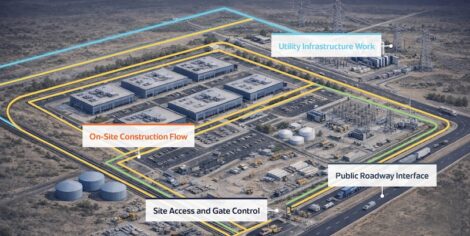
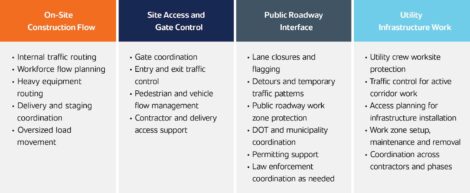
Seen from this perspective, traffic control becomes part of the operating system that helps a complex construction site function safely and predictably.
Safe, More Predictable Execution
On every construction site, the value of traffic control is measured in execution discipline. With billions of dollars invested in a single data center, even routine disruptions can carry significant consequences — from safety exposure to lost productivity that costs millions.
By integrating traffic management early in the planning stages and adjusting it by phase, project teams can improve site flow, reduce contractor conflicts and maintain safer movement around high-risk work zones. Just as importantly, they gain better control over the daily conditions that influence schedule performance.
As data center campuses become larger and more complex, traffic control should be treated as a core element of construction planning. It’s not simply about directing vehicles — but is crucial for managing the most complex construction environments in the world safely, efficiently and on schedule.
AWP Safety supports data center projects, providing expert traffic control and safety services to ensure high-functioning campuses.
Interested in learning more? Connect with our team!